Ahmed Balaha is a journalist and copywriter based in Georgia with a growing focus on blockchain technology, DeFi, AI, privacy, digital assets, and fintech innovation.
Share
Last updated:
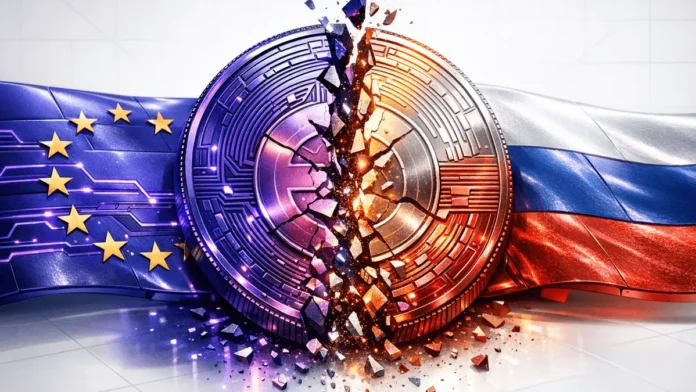
Europe Commission President Ursula von der Leyen announced the EU’s 21st sanctions package against Russia, and buried inside it was an unprecedented legal weapon: the power to ban all crypto-asset services operating from any foreign country found to be helping Russia evade sanctions.
Hours later, on the same calendar day, Russia’s Deputy Finance Minister Ivan Chebeskov took the stage at SPIEF 2026 and announced punitive fees of up to 3% on Western-linked stablecoins including USDT and USDC.
INTEL: Von der Leyen says EU will double down with 21st Russia sanctions package, including powers for full third-country bans on crypto-asset services pic.twitter.com/Qia5cv5Llz
— Solid Intel 📡 (@solidintel_x) June 9, 2026
The global crypto market fracture that analysts have warned about for two years just became official policy on both sides simultaneously.
Discover: The Best Crypto to Diversify Your Portfolio
Europe 21st Sanctions Package: What the Crypto Kill Switch Actually Does
The June 9 package is not an incremental tightening, it is a doctrinal escalation. For the first time, the EU is proposing a mechanism that operates at the jurisdiction level, not the entity level. Previous packages named specific exchanges, wallets, and individuals.
The 21st package gives Brussels the authority to designate an entire country’s crypto sector as off-limits if that country is found to be hosting platforms enabling Russia crypto sanctions evasion.
Von der Leyen described the tool in unambiguous terms:
“For the first time we will introduce the possibility of a full third country ban for crypto-asset services. It will act as a strong deterrent for the countries hosting platforms that help Russia evade our sanctions.”
Photo: Von der Leyen
The enforcement chain works like this: the European Commission identifies a foreign jurisdiction, Turkey, UAE, Kazakhstan, Hong Kong are all in the analytical frame as major intermediary hubs for Russian crypto flows, determines it is materially enabling sanctions evasion, and can then trigger a blanket ban on all crypto-asset service activity linking that country to EU-regulated markets.
Any exchange, liquidity provider, or settlement layer touching that jurisdiction gets cut off from European counterparties.
The 21st package also extends transaction bans to 20 additional non-EU entities, banks, crypto platforms, and oil traders, and adds 31 Russian banks to the existing transaction ban list.
This follows the 20th package, adopted April 23 and effective May 24, which already banned all Russia-based crypto asset service providers as a category and explicitly prohibited dealings with the state-backed RUBx stablecoin and the digital ruble.
Western crypto firms have been navigating accelerating compliance demands across multiple jurisdictions, the new EU framework adds a third-country exposure risk that no compliance manual currently prices in.
Chainalysis, which described the 20th package as a ‘paradigm shift’ from entity-level pressure to targeting ‘evasion architecture itself,’ now faces an even harder analytical problem: the 21st package means VASPs must assess entire settlement ecosystems and jurisdictional exposure, not just screen named individuals against SDN lists.
The total value received by illicit crypto addresses reached $154 billion in 2025, with Russia-linked flows representing a dominant share, that data point is the explicit legislative rationale behind the stablecoin ban architecture taking shape in Brussels.