Ripple CTO Emeritus David Schwartz stepped into the Zcash crisis on June 7, offering a measured reassurance to ZEC holders rattled by the disclosure of a critical zero-knowledge proof vulnerability in the Orchard shielded pool.
His position: passive holders who never move their coins will not lose their funds, provided the bug was never actually exploited. That condition is doing enormous structural work in a sentence that sounds like comfort.
The core paradox is this. The Orchard vulnerability, patched via an emergency NU6.2 hard fork on June 2, theoretically allowed undetected counterfeit ZEC generation for nearly four years.
Zcash’s own developers cannot prove the exploit was never triggered, because the privacy architecture that makes ZEC valuable also makes supply auditing cryptographically impossible. Schwartz’s reassurance is accurate on its own terms. It cannot be a guarantee.
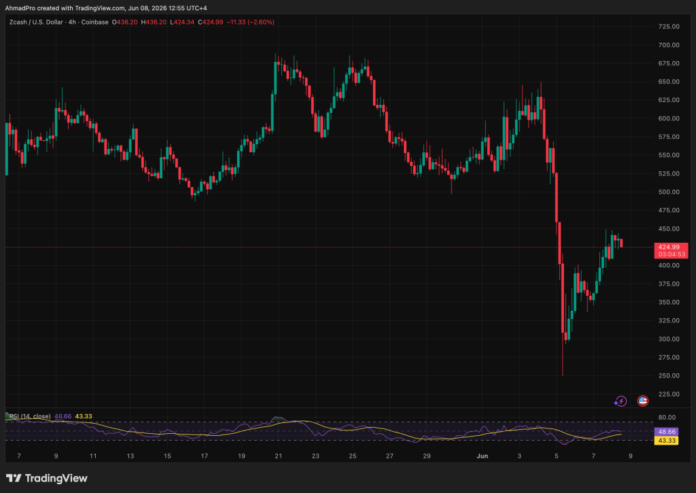
ZEC fell more than 30% in a single session following the May 29 disclosure, briefly touching its lowest level in over a month.
The market was not pricing confirmed exploitation; it was pricing unverifiable risk, which is a different and arguably harder problem to resolve.
What Schwartz’s statement actually means for holders, and whether it changes anything structurally, is what the rest of this article addresses.
Discover: The Best Crypto to Diversify Your Portfolio
The Orchard Pool Bug: What the Vulnerability Actually Means for ZEC
Zcash’s Orchard pool was introduced with Network Upgrade 5 (NU5) in May 2022, the network’s most advanced privacy layer, built on Halo 2-based zk-SNARKs designed to eliminate the trusted setup requirement of earlier Sapling circuits.
The vulnerability resided in an under-constrained element within the elliptic-curve multiplication gadget inside the halo2_gadgets crate. In plain terms, crafted inputs could bypass validity checks and produce counterfeit ZEC that still passed verification.
Zcash engineer Taylor Hornby discovered the flaw on May 29, 2026, reportedly with the assistance of AI-assisted formal methods. He confirmed a fully working exploit in a local regtest environment, and that running the same exploit on mainnet would have generated unlimited, undetectable real ZEC.
The exposure window ran from Orchard’s mainnet activation in May 2022 through June 1, 2026, for approximately 4 years. Affected software included all halo2_gadgets versions before v0.5.0, orchard before v0.14.0, and zcashd versions v5.0.0 through v6.12.3.
Shielded Labs and developers responded rapidly, pushing Zebra 4.5.3 as an emergency soft fork to temporarily disable Orchard transactions, then activating the NU6.2 hard fork via Zebra 5.0 at block 3,364,600 on June 2 at 12:05 PM UTC+8.
The circuit is now corrected. Here is the part that matters for holders: the patch closes the vulnerability going forward, but cannot retroactively prove supply integrity was maintained during those four years. That window is permanently opaque.
Ripple Schwartz’s Reassurance: What It Means and What It Cannot Prove
The discussion surfaced after crypto commentator Nate, known on X as @satorinakamoto, challenged whether Zcash could prove the vulnerability had never been triggered, given the network’s opacity.
Schwartz, co-creator of the XRP Ledger and one of the more technically credible voices in the industry, responded directly: ‘They’ll eventually be a bit lonely in the deprecated pool, but they’ll still be safe and accessible.’
His broader point: consensus rules protect every ZEC owner, and protocol designers can define backward compatibility so passive holders retain valid, spendable coins even as the Orchard pool becomes a legacy layer.
The stated reassurance is that holders will not forfeit assets. That is true conditionally; if no exploit occurred, unmoved funds in older pools remain intact. The condition itself, however, is the entire problem.
Shielded Labs stated explicitly in its disclosure: ‘There is no definitive way to determine, using only cryptography, whether such exploitation occurred.’ Schwartz’s credentials lend his statement genuine weight. What they cannot lend it is certainty about a four-year window inside a privacy coin’s most opaque layer.
This is not a dismissal of Schwartz’s view. His framing, that passive holders are safe absent confirmed exploitation, is technically coherent. The actual framing is that ‘absent confirmed exploitation’ is not a condition anyone can verify, including Zcash’s own developers. Both statements can be simultaneously true. The market is pricing the gap between them.
Discover: The Best Token Presales
The post Ripple CTO Says Zcash Holders Are Safe, But the Bug That Could Have Created Fake ZEC for 4 Years Cannot Be Disproven appeared first on Cryptonews.